

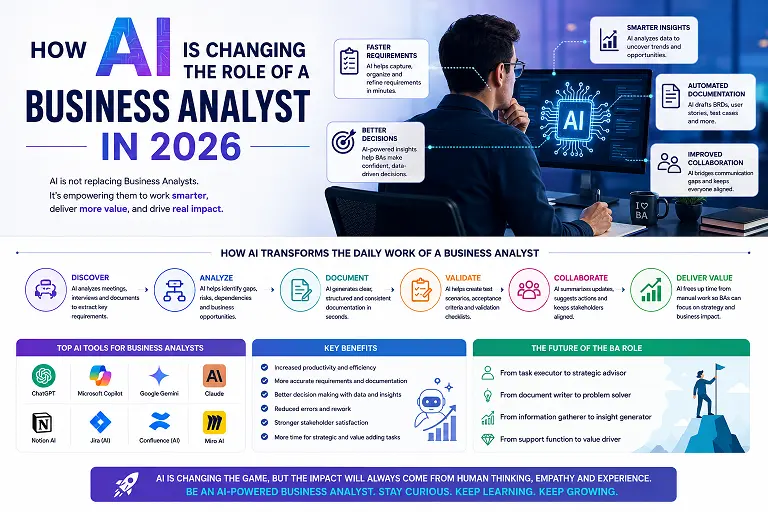
Artificial Intelligence is no longer a futuristic concept. It has become an essential part of modern businesses, helping organizations automate repetitive tasks, improve decision-making, and deliver better customer experiences. One profession that is experiencing a significant transformation because of AI is Business Analysis, which has created a new role called ‘AI Business Analyst’.
If you are wondering whether AI will replace Business Analysts or simply change the way they work, you are not alone. This question is one of the most searched topics among professionals entering or growing in the Business Analysis field. It’s time to become an AI Business Analyst.
The good news is that AI is not replacing Business Analysts. Instead, it is helping them become more productive, strategic, and valuable to their organizations.
In this article, we will explore how AI is changing the role of a Business Analyst in 2026, the skills every Business Analyst should develop, the best AI tools available today, and how you can stay ahead in this rapidly evolving industry.
Why AI is Becoming Essential for Business Analysts
Business Analysts are responsible for understanding business problems, gathering requirements, communicating with stakeholders, documenting solutions, and ensuring successful product delivery. Many of these activities involve analyzing large amounts of information, preparing documentation, and identifying patterns.
This is where Artificial Intelligence makes a significant difference.
Instead of spending several hours creating meeting notes, writing requirement documents, or organizing user stories, Business Analysts can now use AI to complete these activities within minutes. This allows them to spend more time solving business problems rather than performing repetitive administrative tasks.
Organizations are also adopting AI because it helps teams improve productivity without compromising quality. Here comes the role of an AI Business Analyst who can optimize their performance.
How AI is Transforming Business Analysis
Faster Requirements Gathering
Requirement gathering has always been one of the most important responsibilities of a Business Analyst. AI can now analyze meeting transcripts, emails, support tickets, and stakeholder discussions to identify business requirements automatically.
Rather than starting with a blank document, AI Business Analysts receive a structured draft that can be refined and validated with stakeholders.
This significantly reduces documentation time while improving consistency.
Smarter Documentation
Creating Business Requirement Documents, Functional Requirement Documents, user stories, acceptance criteria, and process documentation often requires considerable effort.
Modern AI tools can generate professional documentation by understanding business conversations and project objectives.
Instead of replacing the Business Analyst, AI becomes a writing assistant that accelerates documentation while allowing the analyst to review and improve the final output.
Better Data Analysis
Business Analysts frequently work with reports, spreadsheets, dashboards, and customer data.
AI can quickly identify trends, anomalies, customer behavior, and performance metrics that might otherwise take hours to discover manually.
This enables AI Business Analysts to provide stronger recommendations backed by meaningful insights.
Improved Stakeholder Communication
Every stakeholder communicates differently.
Some prefer detailed reports, while others only want executive summaries.
AI helps Business Analysts create communication tailored to different audiences. A detailed requirement document can quickly become a concise management summary or a presentation for senior leadership.
This improves collaboration across the organization.
Best AI Tools for Business Analysts
Several AI tools have become part of the daily workflow of Business Analysts in 2026.
ChatGPT helps generate requirements, user stories, acceptance criteria, emails, meeting summaries, and brainstorming ideas.
Microsoft Copilot assists with Microsoft Word, Excel, PowerPoint, Outlook, and Teams, making documentation and reporting significantly faster.
Google Gemini helps analyze documents, summarize information, and support research activities.
Claude is particularly useful for reviewing long documents, identifying missing information, and improving requirement quality.
Perplexity AI allows Business Analysts to perform research with referenced sources, making it easier to validate industry information.
The most successful AI Business Analysts do not depend on a single AI tool. Instead, they combine multiple tools depending on the task they need to accomplish.
Skills Every Business Analyst Should Learn in the AI Era
Although AI is changing the way Business Analysts work, core Business Analysis skills remain extremely valuable.
Professionals should continue improving their ability to communicate with stakeholders, understand business objectives, solve complex problems, and think critically.
At the same time, several new skills are becoming increasingly important.
Learning how to write effective AI prompts helps generate better outputs.
Understanding API integrations allows AI Business Analysts to work more effectively with technical teams.
Knowledge of data analysis, automation, process optimization, and AI governance is becoming highly desirable across industries.
Business Analysts who combine traditional analytical thinking with AI capabilities will have a significant advantage in the job market.
Will AI Replace Business Analysts?
This is probably the most common question asked by professionals.
The simple answer is NO.
AI can generate documents, summarize conversations, and suggest ideas. However, it cannot replace human judgment, stakeholder management, negotiation, empathy, or business decision-making.
A successful AI Business Analyst does much more than write documentation.
They identify hidden business problems, ask meaningful questions, resolve conflicts between stakeholders, prioritize requirements, and ensure that technology aligns with business goals.
These responsibilities require human experience, communication, and strategic thinking.
AI supports these activities but does not replace them.
Challenges of Using AI in Business Analysis
Despite its advantages, AI also comes with certain challenges.
Generated content should always be reviewed for accuracy.
Business-sensitive information should only be shared with approved AI platforms that comply with organizational security policies.
IT Business Analysts should also avoid accepting AI-generated outputs without validation.
AI is most effective when it works alongside experienced professionals who understand the business context.
The Future of AI Business Analysts
The future of AI Business Analysts is exciting.
Organizations are increasingly expecting Business Analysts to understand Artificial Intelligence, automation, analytics, and digital transformation.
Instead of focusing only on documentation, Business Analysts are becoming strategic advisors who help organizations identify opportunities, improve customer experiences, and drive innovation.
As AI continues to evolve, the demand for AI Business Analysts who know how to use AI effectively will continue to grow.
Professionals who embrace continuous learning and adapt to new technologies will remain highly competitive in the years ahead.
Final Thoughts
Artificial Intelligence is changing the role of a Business Analyst, but it is not reducing its importance. Instead, it is helping Business Analysts become faster, smarter, and more efficient.
The future belongs to professionals who combine strong business knowledge with modern AI capabilities. By learning how to use AI tools effectively, improving analytical thinking, and maintaining excellent communication skills, Business Analysts can create greater value for their organizations than ever before.
Whether you are an aspiring Business Analyst or an experienced professional, now is the perfect time to embrace AI and prepare for the future of Business Analysis.
Frequently Asked Questions
Is AI replacing Business Analysts?
No. AI automates repetitive tasks, but Business Analysts remain essential for stakeholder communication, decision making, requirement validation, and strategic planning.
Which AI tool is best for Business Analysts?
ChatGPT, Microsoft Copilot, Claude, Google Gemini, and Perplexity AI are among the most popular choices. The right tool depends on your workflow and organizational needs.
Should Business Analysts learn AI?
Yes. Understanding AI tools, prompt writing, automation, and data analysis can significantly improve productivity and career opportunities.
Can freshers use AI to become better Business Analysts?
Absolutely. AI can help beginners learn documentation, understand business concepts, practice writing user stories, and improve analytical skills. However, practical experience and critical thinking remain essential.

AI + Business Analysis Consultant. Helping Business Analysts work smarter with AI.

Leave a Reply