

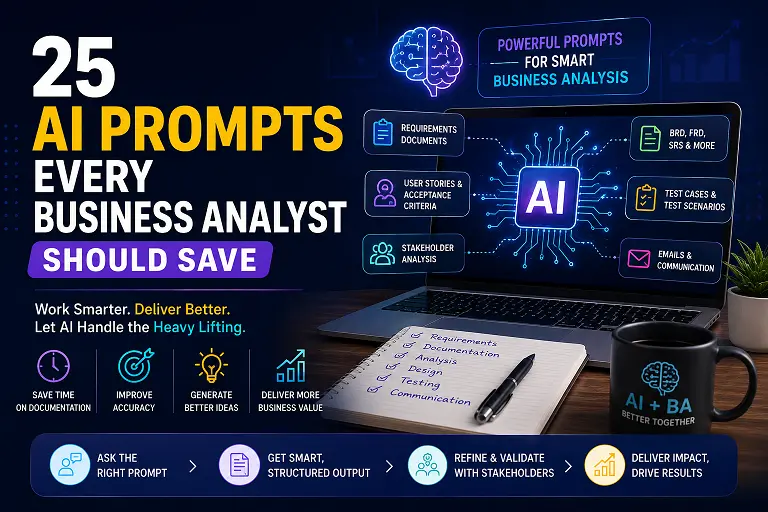
25 AI Prompts for Business Analysts Every Professional Should Save
Artificial Intelligence has become one of the most valuable productivity tools for modern Business Analysts. Instead of spending hours creating requirement documents, user stories, meeting notes, or stakeholder communications, Business Analysts can now use AI to complete these tasks in minutes while maintaining quality.
However, the quality of AI generated responses depends heavily on the prompts you provide. A vague prompt usually produces a generic answer, while a well written prompt delivers detailed and actionable results.
In this guide, you will discover 25 AI Prompts for Business Analysts that can save time, improve productivity, and help you deliver higher quality work throughout the Software Development Life Cycle.
Whether you are a beginner or an experienced Business Analyst, these prompts will become a valuable addition to your daily workflow.
Why Every Business Analyst Should Use AI Prompts
AI is not here to replace Business Analysts. Instead, it acts as a smart assistant that helps with documentation, analysis, brainstorming, and communication.
Using AI effectively allows Business Analysts to:
- Save time on repetitive tasks
- Improve documentation quality
- Generate ideas quickly
- Identify missing requirements
- Create better user stories
- Enhance stakeholder communication
The key is knowing what to ask.
25 AI Prompts for Business Analyst
1. Gather Business Requirements
Act as a Senior Business Analyst. Ask me discovery questions to gather complete business requirements for my project.
2. Create a Business Requirement Document
Create a detailed Business Requirement Document using the following information. Include objectives, scope, assumptions, constraints, risks, stakeholders, and functional requirements.
3. Generate Functional Requirements
Convert the following business requirements into detailed functional requirements suitable for developers.
4. Write User Stories
Create Agile user stories using the format “As a… I want… So that…” along with acceptance criteria.
5. Improve Acceptance Criteria
Review the following acceptance criteria and make them clearer, measurable, and testable.
6. Identify Missing Requirements
Review this requirement document and identify missing functional and non functional requirements.
7. Create Process Flow
Convert the following business process into a step by step workflow and explain each stage.
8. Stakeholder Analysis
Identify all possible stakeholders for this project and categorize them based on influence and interest.
9. Risk Analysis
List the business, technical, and operational risks associated with this project.
10. API Documentation Review
Review this API documentation and explain each endpoint in simple business language.
11. API Test Scenarios
Generate positive, negative, and edge test scenarios for the following API.
12. SQL Query Assistance
Write SQL queries to validate business data for the following scenarios.
13. Meeting Minutes
Convert the following meeting transcript into professional Minutes of Meeting with action items.
14. Requirement Validation
Review these requirements and identify ambiguities, inconsistencies, and duplicate statements.
15. Competitor Analysis
Compare our product with the following competitors and identify strengths, weaknesses, opportunities, and gaps.
16. Root Cause Analysis
Perform a root cause analysis for the following business problem using the Five Why technique.
17. Requirement Prioritization
Prioritize the following requirements using the MoSCoW method and explain your reasoning.
18. Sprint Planning
Break these requirements into sprint ready user stories with estimated complexity.
19. Create Test Cases
Generate detailed functional test cases from the following requirements.
20. Executive Summary
Summarize this twenty page requirement document into a one page executive summary.
21. Email Draft
Write a professional email requesting clarification on the following business requirements.
22. Presentation Creation
Create a presentation outline explaining this project for senior management.
23. Gap Analysis
Compare the current process with the proposed process and identify all gaps.
24. Documentation Review
Act as a Senior Business Analyst and review my document for clarity, completeness, and consistency.
25. Interview Preparation
Ask me twenty Business Analyst interview questions based on this job description and evaluate my answers.
Tips for Writing Better AI Prompts
Getting useful responses is not only about asking questions. It is about providing enough context.
When writing AI prompts:
- Define the role clearly.
- Mention the business domain.
- Explain the expected output.
- Include constraints.
- Provide examples whenever possible.
- Ask AI to think step by step.
- Request the output in a table if required.
A detailed prompt almost always produces better results than a short one.
Best AI Tools for Business Analysts
These prompts work well with most modern AI platforms.
Each tool has unique strengths, but the prompts remain largely the same.
Final Thoughts
Learning AI Prompts for Business Analysts is becoming an essential skill rather than an optional one. As organizations continue adopting Artificial Intelligence, Business Analysts who know how to communicate effectively with AI will deliver better documentation, faster analysis, and higher quality business outcomes.
Instead of treating AI as a shortcut, use it as a collaborative assistant that enhances your expertise. The prompts shared in this guide can help you save hours every week while improving the consistency and quality of your work.
Save this page, bookmark these prompts, and continue refining them based on your projects. The more context you provide, the better the results AI will generate.
Frequently Asked Questions
What are AI prompts for Business Analysts?
AI prompts are structured instructions that help AI tools generate requirements, user stories, documentation, meeting summaries, and other Business Analysis deliverables.
Which AI tool is best for Business Analysts?
Popular options include ChatGPT, Microsoft Copilot, Claude, Google Gemini, and Perplexity AI. The best choice depends on your workflow and organization.
Can beginners use these AI prompts?
Yes. These prompts are suitable for both beginners and experienced Business Analysts. They help improve productivity while reinforcing Business Analysis best practices.

AI + Business Analysis Consultant. Helping Business Analysts work smarter with AI.
Leave a Reply